

Table of Contents
- Xbox Series S vs Xbox Series X: The Core Differences
- Comparing Xbox Series S vs Series X Specs
- Xbox Series S vs Series X Performance: What You'll Actually Notice
- Xbox Series S vs Series X Price: Budget vs Premium
- Which Xbox Should I Buy? A Practical Buying Framework
- Common Mistakes When Choosing Between These Consoles
- Frequently Asked Questions
Last Updated: October 16, 2026
Xbox Series S vs Xbox Series X: The Core Differences
When you're deciding between the Xbox Series S and the Xbox Series X, you're really choosing between two different gaming philosophies. The Series X is the powerhouse designed for those who want maximum performance and future-proofing. The Series S is the pragmatic choice for gamers who want current-generation gaming without the premium price tag.
Both consoles run the same games and access the same Game Pass library. But they approach performance differently. Think of it this way: the Series X is built to dominate for the next seven to eight years. The Series S is built to deliver solid performance now, with the understanding that you might upgrade sooner.
The decision usually comes down to three factors: your display, your budget, and how long you plan to keep the console. Get those three things right, and the rest becomes obvious.
Comparing Xbox Series S vs Series X Specs
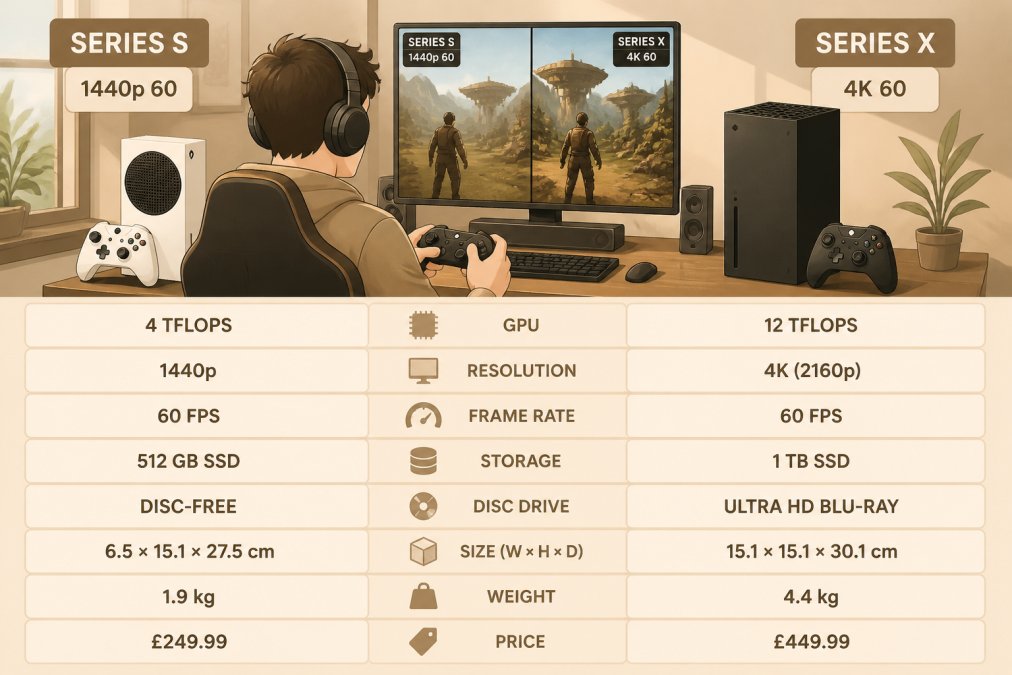
The headline specs tell part of the story, but not all of it. Here's what actually matters when comparing the Xbox Series S vs Series X.
Processing Power and Graphics
The Xbox Series X delivers 12 teraflops of GPU power (Xbox Series X: A Closer Look at the Technology Powering the Next Generation). The Series S delivers 4 teraflops. That's a three-to-one difference, and it sounds dramatic until you understand what it means in practice.
The Series X targets 4K resolution at 60 frames per second in most games, with some titles hitting 120fps. The Series S targets 1440p at 60fps, though many games run at 1080p instead. On a smaller screen or from a normal viewing distance, that difference shrinks considerably.
Where the power gap matters most is in older, poorly optimised games and in how long each console stays relevant. The Series X will handle demanding games with higher settings for longer. The Series S will eventually hit a performance ceiling, probably around 2028 or 2029, when developers stop optimising for it and start pushing the Series X harder.
Storage and Load Times
Both consoles use custom solid-state drives that are dramatically faster than previous generations. The Series X has 1TB of storage (XBOX Series X). The Series S has 512GB (XBOX Series S).
Here's the practical issue: games are getting larger. A modern AAA title takes 100-150GB of space. The Series S's 512GB sounds reasonable until you realise that the operating system takes up space, and you can really only install three or four large games at once. The Series X gives you breathing room to install six or seven.
Load times are nearly identical between the two consoles when playing games installed on the internal drive. The difference emerges when you're installing games or managing your library. The Series X's extra storage means fewer decisions about what to delete.
Xbox Series S vs Series X Performance: What You'll Actually Notice
Performance differences on paper don't always match what you see on screen. Here's what actually changes your gaming experience.
If you're playing on a 1080p or 1440p display, the difference between the Series S and Series X becomes almost invisible. Most people own 1440p monitors or smaller TVs. On those screens, both consoles look sharp and play smoothly. You won't feel cheated playing on a Series S.
If you're playing on a 4K display, the Series X pulls ahead noticeably. Games look crisper. The frame rate stays higher in demanding scenes. But here's the thing: a 4K display costs significantly more than a console. If you're not already committed to 4K gaming, the Series S paired with a good 1440p display will satisfy you completely.
The performance difference matters most for competitive games where frame rate directly affects your ability to react. In fast-paced shooters or racing games, the Series X's ability to maintain higher frame rates gives you a measurable advantage. In single-player story games, the difference is almost unnoticeable.
Xbox Series S vs Series X Price: Budget vs Premium
Pricing on these consoles changes periodically, so we recommend checking Gamerium's website for current prices. What matters is understanding the value equation.
The Series S costs significantly less than the Series X. That price difference is real money, and for many gamers, it's the deciding factor. A Series S purchase leaves you with budget for games, Game Pass, or a better display to pair with it.
The Series X costs more upfront but holds its value longer. If you're the type of gamer who keeps a console for six or seven years, the Series X's extra power means you'll be playing new releases comfortably for longer. The Series S might feel underpowered by 2029 or 2030.
Game Pass changes the equation too. Both consoles access the same Game Pass library. If you're primarily playing Game Pass titles rather than buying individual games, the Series S becomes even more attractive because you're getting current-generation gaming at a lower entry price.
Which Xbox Should I Buy? A Practical Buying Framework
Stop thinking about specs and start thinking about your actual gaming life. Here's how to decide.
Choose the Series S If
You primarily play single-player story games or slower-paced multiplayer titles. You own a 1440p display or smaller. You plan to play Game Pass titles rather than buying individual AAA games. You're budget-conscious and want to spend less upfront. You're comfortable upgrading in four to five years.
You game casually, a few hours per week. You're new to current-generation gaming and want to test the waters without maximum investment. You have limited shelf space or want a smaller, quieter console.
Choose the Series X If
You own a 4K display and want to take advantage of it. You play competitive multiplayer games where frame rate matters. You buy individual games rather than relying on Game Pass. You want maximum future-proofing and plan to keep the console for seven-plus years.
You're a performance enthusiast who values the highest settings and frame rates. You want the confidence that new releases will run smoothly throughout the console's lifecycle. You plan to play demanding games like the latest Forza or Call of Duty at maximum settings.
| Decision Factor | Choose Series S | Choose Series X |
|---|---|---|
| Display | 1440p or smaller | 4K |
| Game library | Game Pass focused | Individual purchases |
| Gaming style | Casual, story-driven | Competitive, demanding |
| Budget priority | Lower cost matters | Performance matters |
| Upgrade timeline | 4-5 years | 7+ years |
Common Mistakes When Choosing Between These Consoles
Most people overthink the specs and underthink their actual gaming habits. Here are the mistakes we see repeatedly.
Mistake one: Assuming you need 4K. Many gamers buy the Series X because they think 4K is essential, then play on a 1440p display anyway. The Series S would have served them perfectly. If you don't already own a 4K display, the Series S is the smarter choice.
Mistake two: Ignoring storage constraints. The Series S's 512GB feels adequate until you own it. Then you're constantly managing storage, deleting games to make room for new ones. If you like variety and want multiple games installed, the Series X's extra space prevents frustration.
Mistake three: Overestimating how long you'll keep it. Most console owners upgrade every five to six years, not seven or eight. At that timeline, the Series S's performance is perfectly adequate. You don't need to pay for eight years of future-proofing if you'll upgrade in five.
Mistake four: Forgetting about the complete setup cost. A Series S is cheaper than a Series X, but a Series S paired with a quality 1440p monitor and a Game Pass subscription costs more than a Series X alone. Think about the whole system, not just the console.
Mistake five: Choosing based on what others recommend. Your mate might swear by the Series X, but if you're a casual player with a smaller display, the Series S is the better choice for you. Gaming preferences aren't universal.
The Xbox Series S vs Series X decision isn't really about which console is objectively better. It's about which console matches your gaming life, your display, and your budget. The Series S is the pragmatic choice for most gamers. The Series X is the choice for those ready to commit to premium gaming. Both are excellent consoles that will deliver great gaming experiences for years.
At Gamerium, we stock both consoles and can help you find the right fit. We offer free UK delivery on all orders, hassle-free returns within 30 days, and competitive pricing. Whether you choose the Series S or the Series X, we'll get it to you quickly and securely. Browse our Xbox selection today and find your next gaming console.
Frequently Asked Questions
What is the main difference between Xbox Series S and Series X?
The Series X is the more powerful console, delivering higher frame rates and resolution (up to 4K at 120fps), whilst the Series S targets 1440p at 120fps. The Series X also has double the storage capacity and a faster processor. Both consoles play the same games and access Xbox Game Pass, but the Series X handles demanding titles more smoothly at higher visual settings.
Can the Xbox Series S play games in 4K?
The Series S targets 1440p resolution for most games, not native 4K. However, some titles use upscaling technology to enhance visuals towards 4K-like quality. If true 4K gaming is essential to you, the Series X is the better choice, as it delivers native 4K in most modern games.
Is the Xbox Series S worth buying, or should I save for the Series X?
The Series S is excellent value if you play at 1440p resolution or on a smaller screen, enjoy Game Pass, or want to spend less upfront. The Series X justifies the extra cost if you own a 4K television, demand maximum performance, or want future-proofing for demanding upcoming releases. Your choice depends on your display and budget, not on gaming ability.
Which Xbox is better for families?
The Series S is ideal for families on a budget, offering full access to Game Pass and family-friendly titles at a lower price point. The Series X suits families with a 4K TV who want the best performance for all game types. Both consoles support multiple user profiles and parental controls, so the decision comes down to your display and spending limit.